
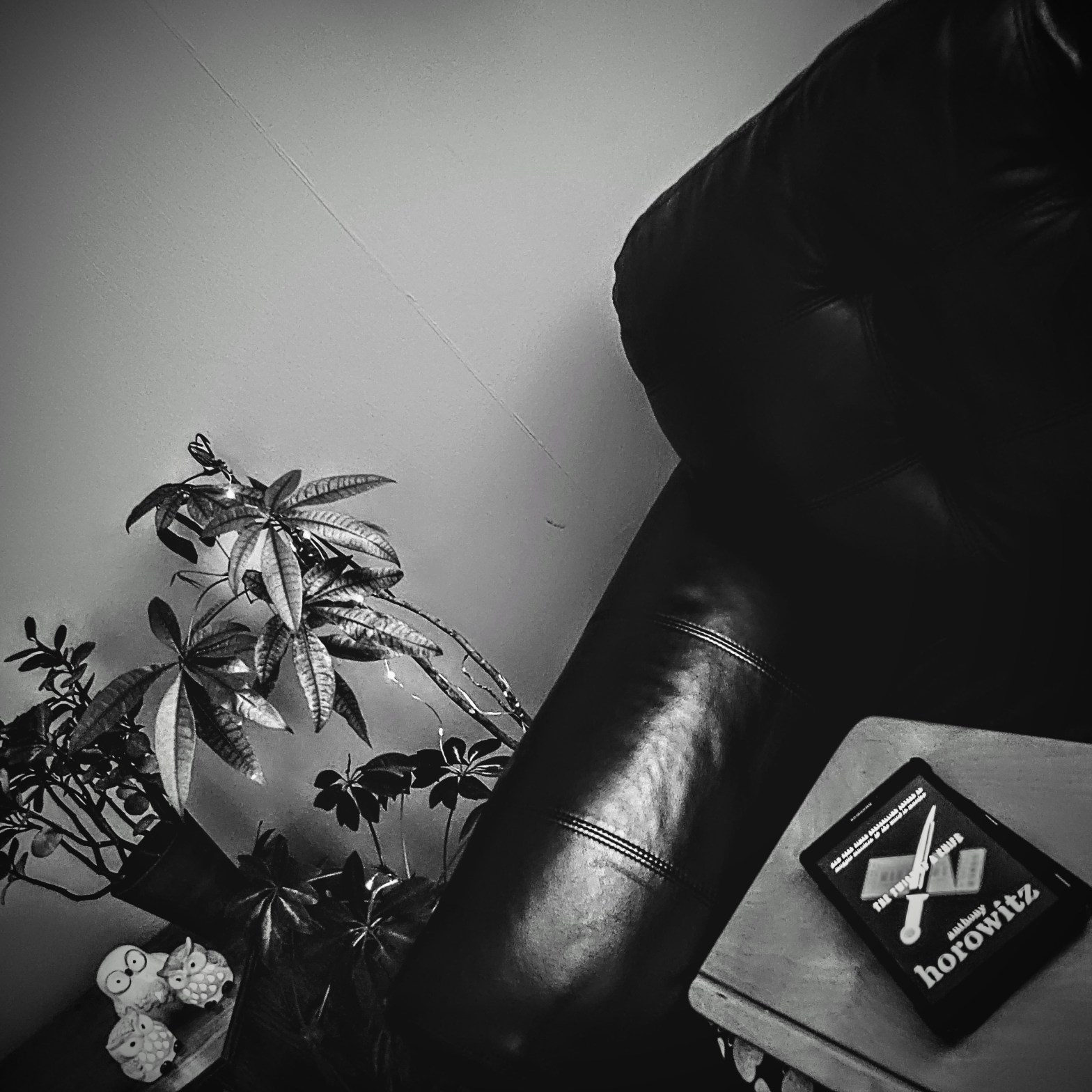
The Twist of a Knife is the fourth book in a series where author Anthony Horowitz writes a version of himself into the book as he and fictional detective Daniel Hawthorne solve murders “together” and collaborate on true-crime books about them.
“It’s amazing, really, the invisible process that can turn complete strangers into friends.”
A theatre critic writes a scathing review of a play, “Mindgame,” that the real author actually wrote in real life. Predictably, she turns up dead. Predictably, the author is suspected of the murder. Not so predictably, until the bitter end, it actually looks like he’s going to go down for the crime. In fact, at one point, I wondered if it was going to be a Murder of Roger Ackroyd moment. (spoiler: it’s not)
“Why would I believe someone who spends his entire life making stuff up?”
There are plenty of suspects who loathed the victim, and it’s a race against the clock to figure out which of them framed Horowitz. Having cut ties with Hawthorne, the fictionalized Horowitz now has no choice but to turn to him for help. It’s wholly original, just like Horowitz’s other three meta-mysteries, and yet distinctly reminiscent of everything good about the whodunnit genre.
It’s as fast-paced and full of twists as the other three in the series, the best part of all of them being the delightful mix of fact and fiction. The story is stand-alone in that you don’t need to have read the other three to understand and enjoy The Twist of a Knife, although they are worth the read for their own sake.
There’s a fair amount of dry humour, which is one of the things I love about Horowitz’s writing. He can be self-indulgent while at the same time never really taking himself too seriously. The concept of Horowitz as his own main character is still engaging and entertaining. I had wondered if the concept might have gotten tired by the fourth novel, but such is not the case. The world of theatre is one that he lives in and brings alive adeptly for the reader, with plenty of name-dropping, of course, and the occasional breaking of the fourth wall.
“Theatre, at its best, is a candle that never goes out and all of these productions, along with many more, still burn in my memory.”
There are moments when the voice that comes across is very much just the author speaking directly to the reader, such as when he gets on his soap box and goes on a rampage about “cultural appropriation” and the “absurdity” of expecting writers to write exclusively about their own experience.
“And so I can’t even try? What does that leave me with? We’ve already agreed that I can’t write about Ahmet or Pranav. So presumably, I can’t write about Maureen or Sky either . . . because they’re both women! Or Lucky because he’s a dog! At the end of the day, if I listened to you, I’d only write about myself! A book full of middle-aged white writers describing middle-aged white writers being murdered by middle-aged white writers!”
As with the entire series, the way Horowitz describes people is perhaps my favourite thing about his writing. He can make you see a person, and not just their appearance, but their whole vibe, just with a few well-selected phrases.
“It was as if he had recognized how few pleasures he had in his life, making him all the more determined to cling on to the few that remained. Murder and cigarettes. That about summed him up.”
In The Twist of a Knife, Anthony Horowitz once again skillfully intertwines reality and fiction. The blend of dry humour, insightful commentary on writing and cultural issues, and the vivid portrayal of characters make this novel a standout in the genre. Despite being the fourth in the series, the concept remains fresh, and Horowitz’s ability to captivate readers with his storytelling prowess shines through, leaving readers eagerly anticipating his next literary endeavour.
“That’s why life is so different to fiction. Every day is a single page and you have no chance to thumb forward and see what lies ahead.”
 Aly Writes