
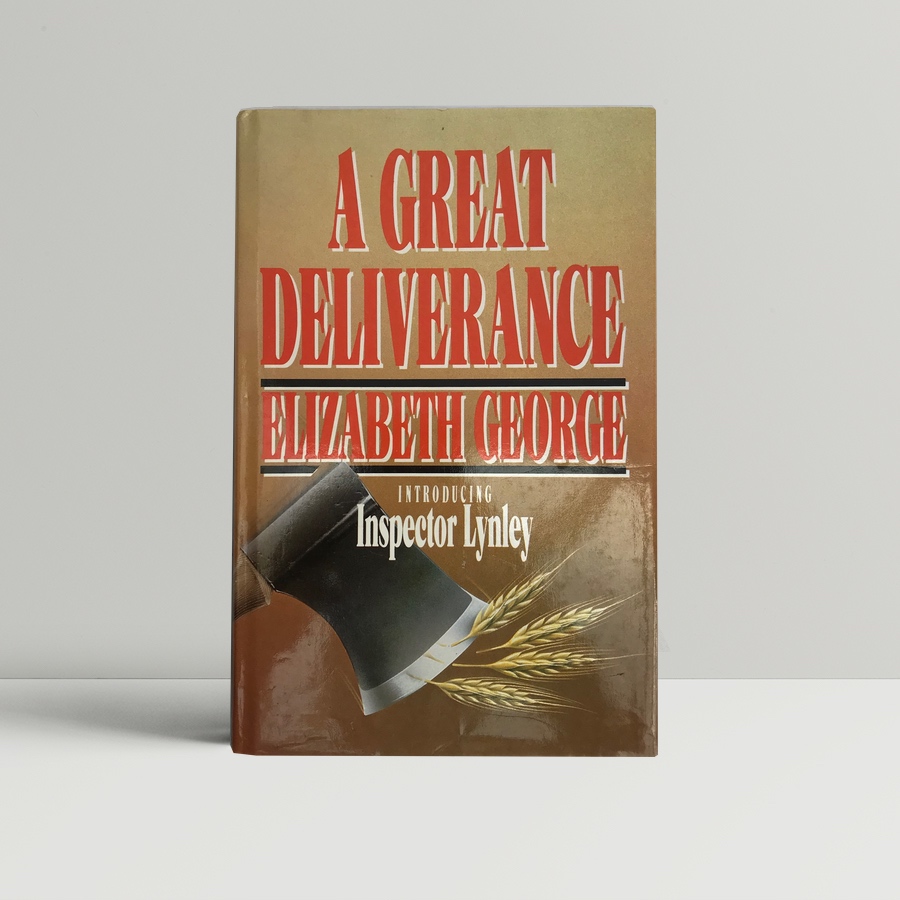
This is the first installment of a new series that I’ll call Reading as a Writer. The point of this series is to learn from those who have succeeded at what I aspire to do. For each chosen novel, I will focus on a half dozen or so elements I want to learn from. My reflections aim to identify what I feel works and what doesn’t. I will sum up each reflection with a brief list of key takeaways: Things Writers Do. Needless to say, these are my own opinions; take them as you will.
Please note that there are spoilers ahead. Do not read on if you prefer not to know the ending.
While reading A Great Deliverance, I paid close attention to: character depth, emotional stakes, multiple suspects, layered motivations, and making the victim matter.
Character Depth:
Elizabeth George created character depth by slowly revealing pieces of the characters’ backstories and by revealing the inner thoughts of other characters, which often contrasted with the characters’ lived reality. For example, Barbara Havers’s thoughts and feelings about Thomas Lynley were almost always opposite to what was actually going on in his mind or what his actual backstory was. This worked well because we learned about the characters by comparing and contrasting what others thought of them, which is more effective than simply telling us who they are because it creates dramatic irony. The reader can see discrepancies between self-perception, other people’s perceptions, and objective behaviour. That allows us to sketch out the character ourselves rather than being handed a complete picture.
I thought this was also particularly effectively done in revealing Gillian Teys’s character entirely by means of what other characters said about her, contradictory though it was, for 90 percent of the book, and then revealing her truth only at the final culmination.
Emotional Stakes:
The emotional stakes were dialled up gradually throughout the story through both the main plot and the subplots of the dead baby and Lynley’s history with, and heartbreak over, Deborah. At times, I found the intertwining subplots distracting and wondered how they related. Still, George seemed to use the love triangle with Deborah to reveal his character more than anything else. The subplot about the dead baby and the side characters, the American couple, felt superfluous to the story at times, pulling the reader’s attention away from the central conflict. Although I suppose the argument could be made that George used this distraction intentionally to further scatter the reader’s attention between competing mysteries.
The most effective thing George did to raise the emotional stakes was to have Lynley visit Roberta and then to have Havers start questioning her strong opinions about Lynley as a result. This marks the start of Havers learning that Lynley is not who she thinks he is, and it foreshadows what she learns about his compassion by the end.
Multiple Suspects:
By slowly revealing the lies other characters told and the secrets they were keeping, George casts suspicion on multiple characters. She skillfully tells the reader that it couldn’t have been Roberta who killed William Teys, which means we have to suspect everyone who had something to hide. It was a very effective way to distract suspicion from the fact that the confessed killer, Roberta, really had done it all along. And it wasn’t a “gotcha” moment at the end, because really, the reader knows all along that Roberta has confessed. It shows George’s skill in convincing the reader not to trust their eyes and ears, so to speak. The reader ends up relying on emotional reaction rather than plain, simple facts. Thus, the reader can gradually realize the truth, culminating in that final, painful confirmation at the end. We are all in denial along with Lynley and Havers throughout the entire novel.
Layered Motivations:
George can so thoroughly convince us that Roberta must be innocent because she reveals every possible motive in the other characters. Richard wants to inherit. Ezra fought with William, who destroyed some of his art. Tessa was caught in bigamy, and her true love left her. Nigel seemed to be hiding something. Everyone seemed suspicious for multiple reasons. I will say, it was almost too much to keep straight at times, but George was trying to distract the reader from the simple truth: Roberta did it.
Making the Victim Matter:
This one baffled me until, three-quarters of the way through the novel, I realized who the victim really was. The victim was never William Teys. It was his two daughters, Roberta and Gillian. Once I realized that, I saw how George had made us care about them throughout. Unfortunately, I did guess fairly early on that William had been sexually abusing his daughters. It seemed blatantly obvious to me as soon as we were told about him “reading the Bible” with Bridie. So, while I think having the obvious victim not be the victim at all is a very effective device for a mystery, I also feel like the abuse storyline was obvious fairly early on and is overused as a shocking motive for murder. The risk in this particular case is crossing the line and turning suffering into a plot device.
Criticism:
What I really did not like about this novel was how George described Roberta. She was described as nearly six feet tall and well over fifteen stone. For a woman almost 6 feet tall, 210 pounds is not morbidly obese. To describe her as a fat, disgusting monster over and over again is just offensive. George should have used other ways to describe how Roberta had not taken care of herself and had tried to make herself unattractive. Additionally, I was constantly annoyed by the excessive use of obscure words I had to look up. Varied vocabulary is wonderful, but George’s word choice is pretentious and unnecessary.
THINGS WRITERS DO:
- Introduce the central mystery early, but delay explanations and gradually supply information that changes the reader’s interpretation of what they already know.
- Use one character’s perceptions and misconceptions to introduce another character, and then let them prove that wrong.
- Give characters a complicated backstory, but rather than spelling it out, reveal it gradually by how they react to situations.
- Make the actual motive and crime simple, and make the reader want to believe it is more complicated.
- Manipulate the reader’s emotional reaction to obfuscate plain, simple facts.

