An 18-Wheeler Is About to Drive Through the Back Seat of Philomena’s Hatchback

When she gets out of the hospital, she’ll go home with a neck brace, a prescription she’ll never fill because pain meds make her feel loopy, a key ring with only the key to her front door, and an appointment to get her stitches out. She’ll register for Netflix to stave off the boredom and binge adventure documentaries when the nightmares steal her sleep. She’ll look around her cluttered apartment and wonder what has changed.

On her first day back at work, with the fading bruises almost hidden under a cakey layer of makeup and a strategic yellow scarf, she’ll find flowers at her desk that make her sneeze. She’ll make it all the way to 1:00 pm, and then she’ll walk into her manager’s office and declare her resignation with a finality that surprises even her. She’ll sit the rest of the day in a drowsy Taco Bell that’s the only thing open within walking distance, drink too much Mountain Dew and wonder what has changed.

After the insurance check comes through, she’ll find herself in a gym. She’ll work and sweat and push herself, endurance training with a furor she never put into her day job. She’ll buy a bicycle. She’ll shower cold every morning, fill herself with protein, stare at the unfamiliar muscles that confront her in the mirror and wonder what has changed.

Her sister will try to stage an intervention when Phil announces that she’s going to climb Everest in the spring. She’ll brush off all their pleas and counsel, and scoff at their concerns. She’ll empty her apartment, making room for all the gear, and spend months trekking at altitude to acclimatize. She’ll reach base camp right on schedule, and beneath strings of fluttering prayer flags, she’ll look up at that mountain and wonder what has changed.

Adrenaline coursing through her, she’ll make the final push for the summit on the 24th of May. As her lungs scream for air, she’ll come across a body in the ice, a crumpled warning, frozen in time. Right there, at 8,500 meters, to the dismay of her guides, she will turn around.

She’ll take down the picture of the mountain on the fridge that’s fueled her drive. She’ll cancel Netflix, turn down three job offers before she accepts the right one, get a cat and four houseplants. Her climbing gear will gather dust in a basement storage locker that she’ll never open again. And on the 17th of August, on the first sunny day that month, she’ll pick up her sister for a family picnic in a new-to-her sedan. Over cold fried chicken and lukewarm potato salad, while the nephews catch frogs and the grownups hope for rain, everyone but Philomena will wonder what has changed.


This piece was first published in Many Nice Donkeys Volume I, Issue IV.

How to Keep Momentum Post-NOVELmber

We’re rapidly approaching the end of November (or at least we were when I wrote this), a month during which, for the past five years, I’ve been setting myself the ludicrous goal of writing 50,000 words of a novel in only 30 days. It’s a marathon of laughable proportions, and I am fully aware that much of what I write is unusable. But it inspires me to plant my butt in a chair and write every day for 30 days in a row, with abandon. It forces me to turn off my inner editor and let my story tell itself at speed, breaking free from strict plans and seeing where the characters take me.

This year, for example, a character who wasn’t even in the pre-planning I did materialized herself out of thin air, showed up at a beach cookout, sat down with my protagonist, and just became her friend. She insinuated herself into the story twice more before I capitulated and agreed to allow her to participate. The things that happen when you’re writing for the joy of writing.

But while the joyous competition against my lack of motivation and the clock results in unprecedented productivity, the month eventually ends. It’s a lovely way to bring some light and excitement into what is a very grey, dark, ugly month in Ontario, but alas, right after November 30th is December 1st. After the marathon of writing, it can be easy to take a much-needed break, get some rest . . . and then not ever get back at it. I have been guilty in the past of setting aside my WIP to give it some breathing space and then not picking it back up for six months or more.

Having created this delightful momentum, how can you keep it rolling, albeit at a more balanced pace than 1667 words per day? Here are a few suggestions that I plan to implement over the winter months:

  1. Celebrate your achievement. I mean, you’ve just written 50,000 words in one month. That is an accomplishment! Take a moment and give it the credit it’s due. My celebration this year involves me, some tacos, and a favourite comfort movie. No, I won’t waste my celebration on a new movie that I may or may not enjoy. I’m rewatching a time-tested classic that I’ve seen over and over again that always brings me joy.
  2. Take a short break to recharge yourself, but set a specific date to return to writing.
  3. The every day part of NOVELmber works for me. I am a creature of routine. If I do something every day, I do it every day as if by rote eventually. Having spent 30 days building that habit, I’d like to keep it going by still trying to write every day, even if it is only for five minutes. Try dedicating writing time at the same time each day.
  4. Set a new goal. Having something to work towards is part of motivating yourself. For me, what this looks like is setting an actual target date and determining what I hope to accomplish by that date, whether it’s a word count goal or a number of pages edited, etc. Try setting smaller weekly goals instead of a bigger goal for the month.
  5. Start a new project or return to an older one to revise and edit. If you feel burned out on your November project, it can be refreshing and get the creative juices flowing again if you turn to something fresh.
  6. Reward yourself. I always set up a bit of a rewards system for the month of November, planning ways I’ll celebrate each milestone. There’s no reason not to continue that. People joke about “little treat culture,” but I say baloney. If you achieve a goal, treat yoself.
  7. Reflect on what worked for you during November. Was there a time, place, or writing ritual that helped you get those words on the page? Try to implement that into your regular routine.

The practice of writing is exactly that: a practice. The more you do of it, the better you will get. So if, like me, you’ve created some momentum through NOVELmber, hold onto that and let it propel you forward through the winter and toward your goals.

Though the Smoke May Lift

Set this motley tapestry of emotions alight
and watch it burn.
Convert these unsought sentiments to sparks;
watch them dance into oblivion.
Let me feel nothing.

Free me from the tireless grip of purgatory.
We pray for rest,
but hope means death,
and living—
Living can be bought but at unfathomable cost.

Tear down the four walls of this time-stopped room
and set me free.
Let flames lick clean the bones of what we knew,
and when there’s nothing left but this stabbing pain,
let me feel nothing.

Let me sit in ashes,
lost in the stinging smoke of guilt,
for guilt is grief,
and grief is love,
and though the smoke may lift, an ember of a memory burns on.

Top 10 Places to Write

I had a house to myself for a long weekend in the city. I brought a book I’m halfway through reading and a nice thick one for when I finished that. I brought my novel manuscript to continue proofreading. I planned on adding thousands of words to my WIP and drafting several posts for my blog. I had free time. I had a luscious shady patio. I had umpteen atmospheric cafes nearby.

How much writing would you guess I got done?

If you guessed that I spent the weekend going for long walks with the dog, shopping, working (should have left that at home), and scrolling TikTok without so much as cracking open my manuscript, you are correct. Was it enjoyable? Absolutely. Much-needed and much-appreciated relaxation. But I wanted to write.

I wrote this on that Saturday evening, late: I go home tomorrow at no set time. Being the last-minute creature I am, I’ll probably tote my laptop along to one of the aforementioned cafes before I leave the city and try to churn out a thousand words or so. But so much more could have been accomplished, and I am (not literally) tearing my hair out in frustration at the lack of words flowing to my fingertips.

Just to get some sort of words on some sort of page, I’m going to compile a list of my 10 favourite places to write. Let this inspire you to be more prolific a writer than I currently am.

1. An Atmospheric Café

The smell of coffee. People to watch. Pastries. Quiet corner tables. Wi-Fi. Maybe another person feverishly tapping away at a keyboard. Top-tier creative environment.

2. Near the Water

I will never say no to sitting near a body of water, writing with a view. Whether it’s the wide, tranquil river of my hometown or the ever-changing shore of Lake Huron or a small, pine-bordered northern lake, I’ll take it.

3. Outside Anywhere

Literally anywhere outside on a nice day. Fresh air. Preferably minimal bugs. Not too much sun. Perfection.

4. At My Desk

Well, of course I do a good majority of my writing at my desk. That’s why I have a desk, right? Beverage mandatory.

5. In My Recliner

This one specifically late at night. Writing hits different after 11:00 p.m. when everything is dark and quiet, I’ve got my feet up, and I know I should be sleeping.

6. At Work

Those scribbled notes on scraps of paper from random ideas that pop into my head at work have turned into some of my best writing.

7. In the Car

(Not while driving). Voice notes on the run. Ideas hastily noted in Google Keep. Lines written while the emotion is fresh in mind. These are gems.

8. In the City

I’m a country girl. I am not cut out for city life. But a couple days in the city . . . well, normally it’s quite inspiring. Maybe not this time, but. . .

9. At a Hotel

If you’ve never tried doing writing sprints on a public computer in the “business centre” of a hotel far from home, you don’t know what you’re missing. By this point, you’re probably figuring out that I will accept literally any change of scenery.

10. In Cyberspace

Not a physical location, but hear me out. Writing sprints on Discord with people from all over the world a la the Global Write-In Crawl. Very motivating.

And there you have it. Ten places to write, and I’ve written some words. Maybe tomorrow I’ll actually add something to my WIP. Or I’ll eat an almond croissant and stare at a blank screen and then head home. Could go either way.

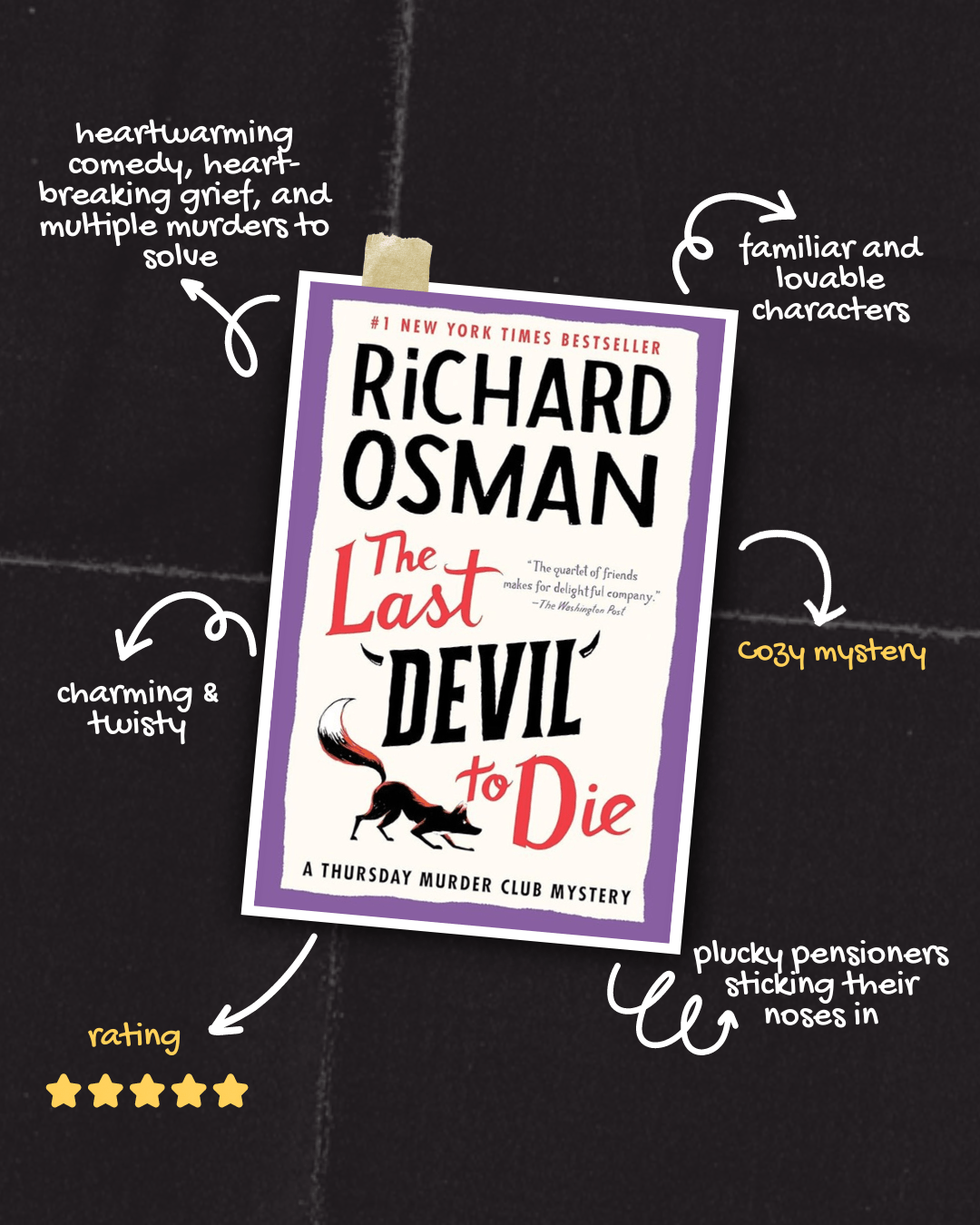
The Last Devil to Die (Richard Osman)

The much-loved gang of pensioners is back, but this time, they’re hoping to investigate something less serious than murder – perhaps just the simple case of a new resident of the retirement village and his almost certainly fraudulent online beau. Nothing doing. An old acquaintance turns up dead, and the four take on the case.

“Friendship, and Joyce flirting unsuccessfully with a Welshman who appears to be the subject of a fairly serious international fraud. Elizabeth could think of worse ways to spend the holidays.”

Richard Osman has outdone himself with this latest instalment, the fourth in the Thursday Murder Club series (sad to say it will be the last for a while, according to Osman, who is soon to release the first in a new series). The bodies pile up, and Elizabeth, Joyce, Ibrahim, and Ron investigate as only they can, extracting information from people and places in manners that the police cannot.

“It’s 90 per cent this, 5 per cent paperwork and 5 per cent killing people.”

The mystery in this book is as elaborate, deadly, and humorous as the preceding three, but I would have to say that The Last Devil to Die is my favourite in the series. The well-rounded, poignant, and often unexpected subplots of this instalment had me laughing out loud and, at times, wiping away tears as each character is put through the wringer in their own way.

‘I know a woman,’ says Ibrahim. ‘A cocaine dealer, who can kill people with the click of a finger. Yet, on Monday, she laid her hand on my arm like a lover.’

I would suggest reading the previous three novels (The Thursday Murder Club, The Man Who Died Twice, The Bullet That Missed) rather than just diving in with this one. It reads much better if you’re already familiar with the characters and their backstories, many of the details of which are not provided in this instalment.

“That’s the thing about Coopers Chase. You’d imagine it was quiet and sedate, like a village pond on a summer’s day. But in truth it never stops moving, it’s always in motion. And that motion is ageing, and death, and love, and grief, and final snatched moments and opportunities grasped. The urgency of old age. There’s nothing that makes you feel more alive than the certainty of death.”

With Elizabeth more occupied than ever as her beloved Stephen’s dementia progresses, Joyce takes more of an active role in the investigations. Since I’ve always especially loved Joyce’s point of view in the series, I enjoyed her stepping forward as more of a leader. I will warn you, though, when it comes to Elizabeth and Stephen’s storyline, you will need tissues. Osman tackles heavy topics around aging, dementia, facing death, and the loss of a loved one with a realistic and empathetic voice.

“But my brain is doubling back on itself. Even now, back I go. It feels like a bathtub, when someone pulls out the plug. Circles, circles, circles, and, every time around, something new, something not understood, and there’s me trying to scramble up the sides.”

“There comes a point when you look at your photograph albums more often than you watch the news. When you opt out of time, and let it carry on doing its thing while you get on with yours.”

Osman masterfully interweaves comedy and heartbreak throughout, developing characters that are truly endearing and genuine. I have become so fond of this hilarious band of elderly detectives – who, by the way, are soon to be immortalized on the screen as well. Hopefully, his hiatus from the series won’t last too long, although I’ve read a sneak peek at his next mystery novel featuring a daughter-in-law/father-in-law duo, which quickly captivated me.

“Waiting for the last devil to die? What a joke. New devils will always spring up, like daffodils in springtime.”

Spoonfed Tragedies

We turn our backs on day-old news
For the suffering that’s trending
And we’re startled by the state of things
As if this story’s not unending

We’re shocked by the injustice
But it’s perpetually the norm
Chasing every shiny conflict
Tracking down the next big storm

We’re fed lollipops and bandaids
To placate hollow tears
And handed fictional monsters
To be the focus of our fears

Everything can be a cause
If it’s shouted loud enough
But who is ever going to hear
The softest, lowest, quietest
Most hushed
Most downtrodden
Most IMPORTANT voice
Above all their trifling guff?

9 MORE Notable Canadian Literary Magazines + 1 Bonus

I’m back again with submission opportunities from more quality Canadian literary magazines (well, nine Canadian and one UK-based). It can be hard to figure out where to send your stories, so I’ve done some of the leg work for you. As always, be sure to familiarize yourself with what type of work these journals publish and, of course, read their submissions guidelines thoroughly. Happy submitting and may all your rejections be personalized!

The Ampersand Review

Who They Are: The Ampersand Review of Writing & Publishing is a literary magazine published in print by the Honours Bachelor of Creative Writing & Publishing program at Sheridan College.

Accepts: Ampersand accepts submissions of poetry, fiction, creative non-fiction, essays, interviews, and book reviews. Priority may be given to submissions written by those who reside in Canada.

Submission Fee: No fee for submissions. Entry fee of $29.95 for essay contest

Compensation: Poetry: $50 per poem/page to a maximum of $100; Fiction: $100 per story; Non-fiction: $100 per piece; Reviews: $100 per piece; Essay contest (entry fee $29.95) winner receives $500 and publication; runner-up $100 and publication; all entrants receive a one-year subscription.

Submission Window: Open for subs from December 1 to January 31. Currently running an essay contest that is open for submissions until June 30, 2024.

Archetype

Who They Are: Archetype is a Toronto-based literary journal that strives to publish creative work—essays, poetry, fiction, interviews, reviews—that reminds us of what it’s like to be made of flesh. Published in print twice a year.

Accepts: “Essays. Poetry. Fiction. Interviews. Reviews. And everything else. Nothing is off limits.” 1,000 to 5,000 words for prose, or 1 to 5 poems.

Submission Fee: none

Compensation: One free print copy of the issue your work is published in.

Submission Window: November 1 to January 7 for spring issue, June 1 to August 6 for fall issue

Broken Pencil

Who They Are: Broken Pencil is a quarterly magazine based in Toronto. Each issue of Broken Pencil features reviews of hundreds of zines and small press books, plus comics, excerpts from the best of the underground press, interviews, original fiction, and commentary on all aspects of the indie arts.

Accepts: Zines, chapbooks, short fiction up to 3,000 words, pitches for articles and reviews.

Submission Fee: Optional submission fee.

Compensation: Between $60 and $120 per piece “depending on the status of their finances.”

Submission Window: Reads submissions year-round.

The Feathertale Review

Who They Are: “Canada’s most decorated small illustrated literary humour magazine. Funny little magazine publishing words and illustrations online and in print since 2006.”

Accepts: Poetry, short fiction, cartoons and sketches. Submissions should be funny. Short fiction up to 2,500 words; poems up to 1,000 words.

Submission Fee: none

Compensation: “We like to pay our online contributors with hugs and thank-you cards. However, any online contributors that see publication in The Feathertale Review will be rewarded monetarily.”

Submission Window: Currently temporarily closed

Hexagon

Who They Are: Online speculative fiction magazine specializing in the weird, the wondrous, and the whimsical. Hexagon publishes quarterly, releasing issues on March 1, June 1, September 1, and December 1.

Accepts: Short stories, flash fiction and comics submissions. Narratives no longer than 10,000 words and comics of 1 to 5 pages. Only speculative fiction.

Submission Fee: none

Compensation: Hexagon pays pay 0.01$ CAD/ word for all short stories up to 10,000 words, and $100 CAD/page for comics.

Submission Window: Open for submissions for the first 7 days of January, March, May, July, September, November.

Mystery Magazine

Who They Are: “Mystery Magazine presents original short stories by the world’s best-known and emerging mystery writers. The stories we feature in our monthly issues span every imaginable subgenre, including cozy, police procedural, noir, whodunit, supernatural, hardboiled, humor, and historical mysteries.” Mystery Magazine publishes digital and print issues, plus on their mobile app.

Accepts: 1,000-to-7,500-word stories.

Submission Fee: none

Compensation: 0.02$ USD per word.

Submission Window: Always open.

Queen’s Quarterly

Who They Are: “Since 1893 the Queen’s Quarterly has published generous and accessible analysis, opinion and reflection in the guise of prose, poetry, fiction, creative non-fiction, art and reportage.” The quarterly is published in print and digitally.

Accepts: Subs on any topic that presents a novel perspective and point of departure for thinking about our contemporary world, fiction or non-fiction. Articles, essays, short stories up to 3,000 words, or up to 6 poems.

Submission Fee: none

Compensation: Payment to new writers will be determined at time of acceptance and paid upon publication.

Submission Window: Open.

The /tƐmz/ Review

Who They Are: ​The /tƐmz/ Review is a literary journal based in London, Ontario that publishes 4 issues per year (Spring, Summer, Fall and Winter), whose goal is to reflect a wide variety of editorial perspectives and publish an eclectic mix of writing.

Accepts: Prose fiction and creative non-fiction up to 10,000 words for the journal. Subs of 1-8 poems depending on the length, preferably 10 pages or fewer. Queries for reviews or interviews.

Submission Fee: none

Compensation: $20 per prose piece; $20 per batch of poems.

Submission Window: Opening June 1, 2024

Toronto Journal

Who They Are: Toronto Journal is a writing journal in print and sound. They publish two issues per year in the summer and the winter.

Accepts: Publishes short stories from anywhere in the world, word limit 7,500. Also considers non-fiction pieces that are either set locally or explore some local history from the GTA and surrounding. All subs to Toronto Journal are anonymous.

Submission Fee: none

Compensation: Pays $50 per piece plus a printed copy.

Submission Window: Currently accepting subs for Winter 2025 issue, deadline October 1, 2024. For summer issue, by April 30 each year. For winter issue, by October 31each year.

Trash Cat Lit

Who They Are: UK-based Trash Cat Lit publishes three issues per year – in April, July, and October – featuring six flash fictions and three short stories per issue.

Accepts: 100 to 750 words for flash fiction and 751 to 2,000 words for short stories.

Submission Fee: none

Compensation: none

Submission Window: open for the first two weeks of March, June, and September or until they reach their cap of 75 flash fictions and 30 short stories


For more fabulous submission opportunities for Canadian writers, see my previous articles, 10 Notable Canadian Literary Magazines, 10 (More) Notable Canadian Literary Magazines, and 10 More (More) Notable Canadian Literary Magazines.


Family Pot Luck is a Dish Best Served Tepid

We file past the buffet, jockeying for position in this begrudging hierarchy, bound by blood and marriage, not by choice. Every year, the dishes are the same.

The secret spice in Aunt Deb’s deviled eggs is her decades-old affair with her sister’s ex-husband. He’s no longer invited, but Deb’s little holiday tradition is to bring him a plate of leftovers on her way home, leaving her husband sleeping it off, belt undone, on her mother-in-law’s couch.

Felicia uses her mother’s recipe for coleslaw, not that it ever measures up. She tries it every year but has no idea that cousin Lauren stirs in extra vinegar on the sly. It’s even more sour than last year, but Lauren’s bloody well tired of cousin Felicia kissing up, so this’ll give her an excuse to purse her lips she won’t forget.

The mashed potatoes are always lumpy, and rarely ever hot. But since Papa Fred is a firm family fave, so are his spuds—unlike Pete and Patty’s green bean casserole, which, like their marriage, has been in the oven far too long and is starting to break down. We scoop it out, regardless, with a ladle Pete’s been accused of stealing from the family homestead for the past 30 years. Everybody knows it’ll go home with Pete and Patty at the end of the night, tucked deep down in her purse.

The main this year is meat—red, rare, bloody slabs of steak charred over flames the height of which demonstrate youngest brother Tom’s masculinity. The only still-unmarried sibling mans the grill the same way he drives his Ford F150 Dually: like he’s got something to prove.

If the baked beans and mac-n-cheese seem a little greasy, it’s because cousins Tabitha and Benjamin have been trying to sabotage each other’s diets. They’ve bet a trip to Bora Bora over who can lose 20 pounds by Easter, and Benny’s already down 7 pounds just by quitting drinking beer.

Of course, Janice is only ever asked to bring napkins because of that one year she messed up the main. She’s such a flake, and only tolerated because she’s engaged to grandson Nick, not that he’ll settle on a date after what—almost five years now?

The only thing that holds it all together—and then the thing that makes it fall apart—is the copious amount of booze supplied by insufferable Barry. He makes a big thing, puffing out his chest, “nothing but the best,” and “no expense spared.” The matriarch smiles benevolently and insists on calling him Doctor Fitzwilliam to make it clear he’s the only son-in-law she approves of.

To top the night is Great Aunt Dotty’s sickly sweet potato pie, but no one’s realized she forgot what step she was on in the recipe and added sugar three times. They’ll finally clue in that her mind is starting to slip when the oven she left on burns down her trailer along with both on either side in Golden Horizons trailer park.

The Marlow Murder Club (Robert Thorogood)

“To solve an impossible murder, you need an impossible hero.”

Judith Potts, a seventy-seven-year-old whisky-drinking crossword puzzle author, lives alone in a rundown Marlow mansion. One evening, swimming nude (of course) in the Thames, she hears what she believes to be her neighbour being shot. The local police are skeptical, but Judith sets about tracking down the killer herself, joining forces with Suzie, the dogwalker, and Becks, the vicar’s wife, along the way.

“If she had one piece of advice she’d give her younger self, it would be: don’t get old.”

I am loving this revived trend of books and series about older people turned sleuths. We need more Jessica Fletchers. With PBS Masterpiece soon to release The Marlow Murder Club as a series, Judith Potts could be our generation’s Miss Marple. She’s clever, feisty, eccentric, and has a totally relatable desire to live her best life untroubled by the interference of others (read: men). I fell in love with Judith immediately.

“The whole point of living on your own was that you didn’t have to share your home with anyone.”

Add prim and proper Becks, who, beneath her perfect housewife façade, is grappling with unadmitted feelings of dissatisfaction and is perhaps not as meek as she seems. And round out the trio with Suzie, a fiercely independent long-time divorcee with a past that she keeps to herself.

“She couldn’t help noticing everything about her existence seemed to be defined by someone who wasn’t her. She was the kids’ mum, the vicar’s wife, and the house’s wife for that matter.”

The dynamic of the trio of main characters is what gives life to this cozy mystery. They’re relatable and well-written, each with their own flaws. Together, they make up the unstoppable Marlow Murder Club, solving what turns out to be serial killings, all while helping each other grow and develop — yes, a cozy mystery novel with genuine, well-written character arcs.

“We’ve got one thing going for us, haven’t we?”

“What’s that?”

“We’re invisible.”

“How do you mean?”

“It’s like I said. We’re ‘older’ women, aren’t we? No one notices women over the age of about forty.”

I particularly enjoyed the interplay between the three amateur sleuths and DS Tanika Malik. Unlike the usual friction between law enforcement who refuse to listen and sleuths who constantly butt heads with the police, Malik knows she’s out of her depth and ends up feeding information to and working along with Judith, Suzie, and Becks. It felt like a refreshing change and another reason why The Marlow Murder Club is not just another formulaic cozy mystery.

Robert Thorogood, creator of Death in Paradise, smashed it out of the park with this light-hearted, cleverly-plotted murder mystery. The Marlow Murder Club, a perfect bit of escapism, left me wanting more, and with two sequels already released and a TV series on the way, there’s plenty to be enjoyed. Highly recommend if you’re looking for a new murder mystery series to fall in love with.

#30Words30Days Part Two

We’ve just finished the second annual challenge over on Twitter to write a 30-word story every day in the month of April. I did a lot of playing catch-up, but here are my tiny stories from the second half of the month. Read Part One over here.

You’ve got to have a thick skin and the ability to blend in to make it around here. It’s harsh, unforgiving, kind words as rare as water in the desert.

Oneday, will I ever break the pattern?
Can I ever be anyone but who I used to be?
One day, will I stand up loud,
Shouting, “No regrets from me?”

Harold tugs at the collar of his shirt, feeling the walls close in. The air is close; his boss is closer, and Harold’s sure he knows. Defeated by silent interrogation.

I don’t remember being told
How much it hurts, this growing old
I am still quite young inside my head
But everyone I love is
Holding on for dear life.

They’re not that different, love from hate, so potent this clashing pair. Where one sprouts, the other can grow; which one’s weeded out is up to no one but you.

She’s a gentle rain
She’s the smell of coming home
She’s as quiet as the morning of the first snowfall
If she were an element, she’d be lithium
She calms

The only indication left that Simon ever existed is the void of unfaded wallpaper where his framed picture used to hang and one mateless sock collecting dust behind the dryer.

Just below the surface of the water rises the bloated former resident of apartment 103, barely recognizable in his fish-nibbled state. Alas, the author of his demise used insufficient weights.

The pitiful thing looked wide-eyed back at me, skin and bones and patchy orange fur. Now stretches like a just-fed lion on the back of my sofa in the sun.

Is it supposed to build character, the way you pushed my heart off a ledge like a housecat nudging glass just to hear it shatter down below? Are you satisfied?

The wind chases ripples in the fields of winter wheat, kissing wavelets in the creek that murmurs past the willow tree, singing bittersweet duets with the mourning dove to me.

I’ve spent 13 years lost in your labyrinth of lies, unraveling myself one stitch at a time, but I’ve got a thread to follow out, and you’ll be left behind.

Arnold always saw the world in shapes, his life a tight square, his future a narrowing triangle. But she was round, his one true love, and suddenly the corners softened.

Once Genevieve comes back down to earth, once love’s cotton candy clouds clear, leaving that lingering feeling of sick in the back of her throat, do you think she’ll bolt?

The air is tinged with essence of spring, all manner of pollination and baby-making. Flowers blossom and leaves unfurl and mamas lead lines of toddling fluff. It’s beautiful, but — A-A-A-AHCHOOO!

They’ll find Edgar facedown at seventh green with his lucky clubs, one shoe missing, and it’ll never be known if it was the booze that caught up or his wife.


Follow WritingDani and WritesAly on Twitter to join in next time!