Looking For a Home For One-Dozen Egg Yolks

“Wherefore they are no more twain, but one flesh. What therefore God hath joined together, let not man put asunder.”

Not that it was a man who put us asunder. No, our sundering was caused by a perky redhead who moved in next door and always needed help with something. Leaky faucet? Oh don’t worry, Gavin will be right over with a wrench and a smile. Car won’t start? Not a problem, Gavin’s very handy under the hood. Furnace on the fritz? Never fear, Gavin’s just the man to get things heated up.

I open the cookbook and start gathering ingredients. Whip 12 egg whites and 1 ½ teaspoons cream of tartar until frothy. That’s one dozen eggs to be put asunder. I use my fingers, letting the white slip down into the bowl, leaving the glistening golden globes one at a time cradled in my hand. So easily done—what once was whole has now been twain.

The yolks get set aside. They’ll go into whatever tupperware I can find a lid for and into the fridge until—in theory—I figure out a use for them. In reality, they’ll get shuffled further and further back until I pull the container out weeks later, having forgotten what it contains, and hold my breath against the smell as I run them down the drain, discarded.

The liberated whites are destined for more exciting things. Once they’re frothy they get a cup of sugar, gradually poured in while whipping until glossy peaks form. A teaspoon of vanilla for flavour (it’s artificial, don’t tell). And now I must be ever so gentle, not crushing this fragile new marriage of egg whites and sugar—after all, it’s built itself up on air. I slowly fold in a cup of cake flour that’s been mixed with another half cup of sugar. The airy mixture threatens to deflate on contact with anything of substance. Softly now, don’t make it face anything too hard.

I spread the batter into a tube pan and place it in the oven for a long, slow 45 minutes at 165°C. Back to those abandoned yolks. I ponder flushing them away, putting their misery to a swift, merciful end, but alas, into the fridge they go to fester away. Why’s there never a recipe that calls for a dozen less-than-fresh egg yolks?

If I’ve done this right, after baked and rested three hours upside down on a bottle, I’ll have a tall, fluffy Angel Food with the flavour and texture of a sponge doused in Granny’s vanilla eau de toilette. That’s why it’s always served buried under berries and dollops of whipped cream. Outer trappings to hide the lack of substance or depth of flavour—that’s the ticket.

I’ll arrange the end result attractively on a plate and carry it next door. Hopefully my new neighbour won’t mind if I ask her husband to take a look at my lawnmower—I haven’t been able to get it started since Gavin left.


This piece was first published online by Leon Literary Review.

Darkness Lingers

All the love I’ve experienced
Has felt like pain
Like a bolt of lightning
Through a warm spring rain

Left me shattered, broken
A shell of myself
Left to pick up the pieces
In this lonely hell

The dawn is waiting
On the other side
If the darkness lingers longer
I might not make it out alive

Hope hurts so much harder
When you’ve felt such loss
And fear tastes bitter
I can love, but at what cost?

Everything that’s precious
Can be stolen away
I can feel my cold heart breaking
Before love’s had a chance to fade

They tell me life gets brighter
But time’s not on my side
If the darkness lingers longer
I might not make it out alive

I can keep trying harder
To win this fight
But if the darkness lingers longer
I might not make it out alive

The Things We Leave Behind

A diverse and engaging anthology, The Things We Leave Behind will resonate with a wide variety of readers. I found myself drawn in from the opening line of most of the stories. Each contributor has interpreted the theme uniquely, immersing the reader in poignant moments that range from humorous to sorrowful, from light-hearted to heart-breaking.

Unfortunately, I found the introduction to be more than I needed. I’ve never appreciated having a story explained to me before I read it—I prefer to dive in and draw my own conclusions, experience and interpret it in my own way. As such, I wished I had read just the part of the foreword that celebrated Canadian literature and introduced the theme of the anthology, and stopped short of the four pages of synopsizing that followed. 

That said, these short stories are by no means short on emotion or depth. They weren’t all for me, but that is the point of a collection of stories—different readers will be drawn to different pieces. A particular favourite is the breathlessly spiraling On Edge by Barbara Lehtiniemi; it’s a tremendously relatable story that left me with a smile.

“And you need someone like that in the country where problems are not unusual but tangled into the fabric of everyday life . . . and you’re more of a hand wringer than a problem solver but you hope people don’t think that even if you do.”

On Edge, Barbara Lehtiniemi

I’ve taken a second and third read through Five Sorrowful Mysteries by Ronald Zajac. The first time I read it, I scrawled on a post-it note: “I think I like it? Maybe?” It is one of the stand-out pieces of this anthology, and as I peeled back the layers, I found meaning in it that demands more than a cursory skim.

“He never even went to the funeral; he found out about it too late. Cancer sucks. So do life and distance and the inexorable erosion of unattended friendship.”

Five Sorrowful Mysteries, Ronald Zajac

Ace Baker’s Menos Coca, Mas Cacao genuinely surprised me with its clever repetition and sudden twist. I was engrossed from the opening line:

“The land is my love—a land of happiness and hopelessness, of beauty and brutality.”

Menos Coca, Mas Cacao, Ace Baker

Not only did I recognize the landscape many of the stories were set in, but I also recognized myself in them. For better or worse, we all have things we’ve left behind.

“Yet not all choose to grieve what they’ve left behind.”


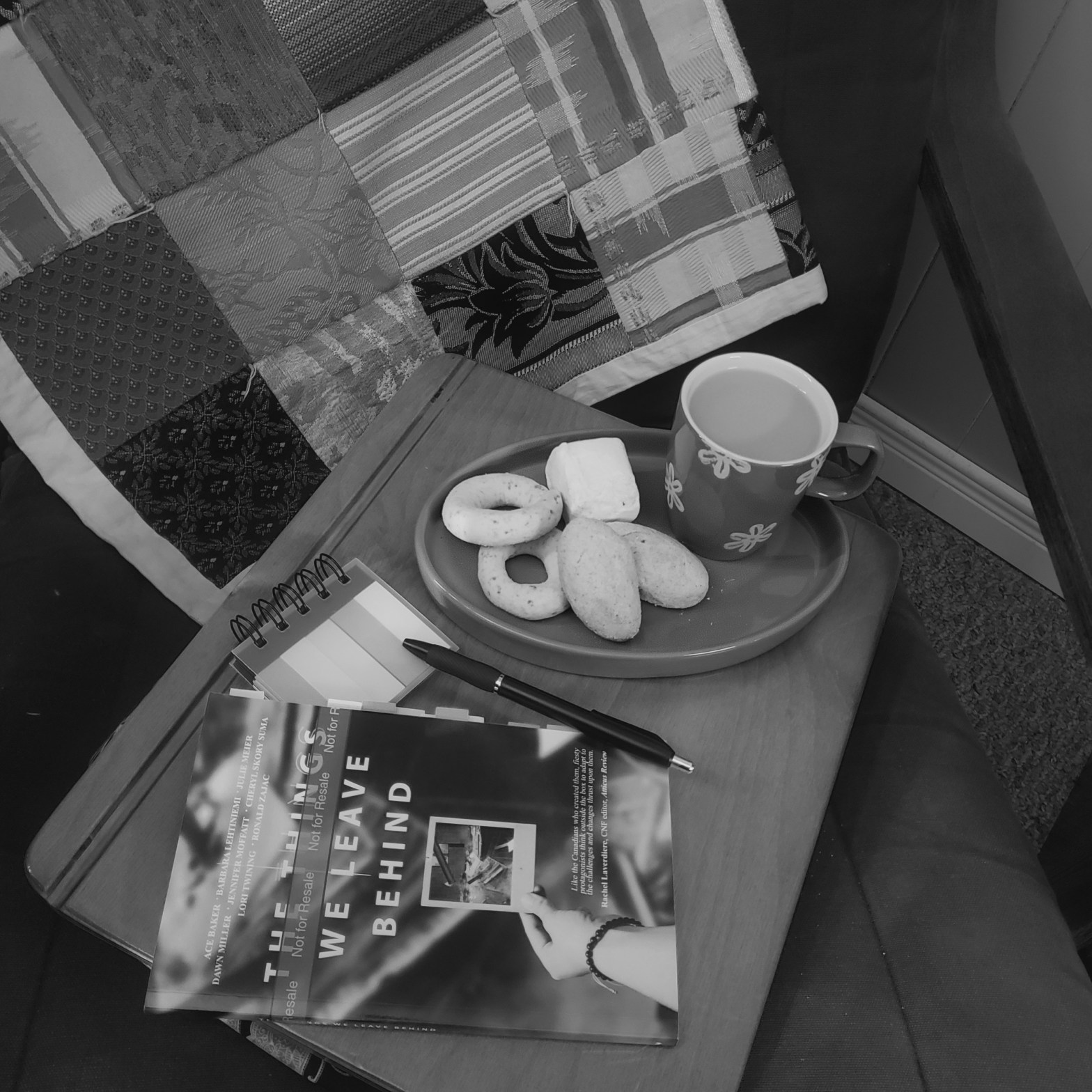
The Things We Leave Behind is an anthology of eight short stories published by Chicken House Press. These stories offer a glimpse at Canada’s geographic landscape—spanning the Yukon, Canadian Prairies, Great Lakes, and metropolitan Toronto while starring protagonists who are well-storied in loss.

Newfoundland Molasses “Lassy” Buns

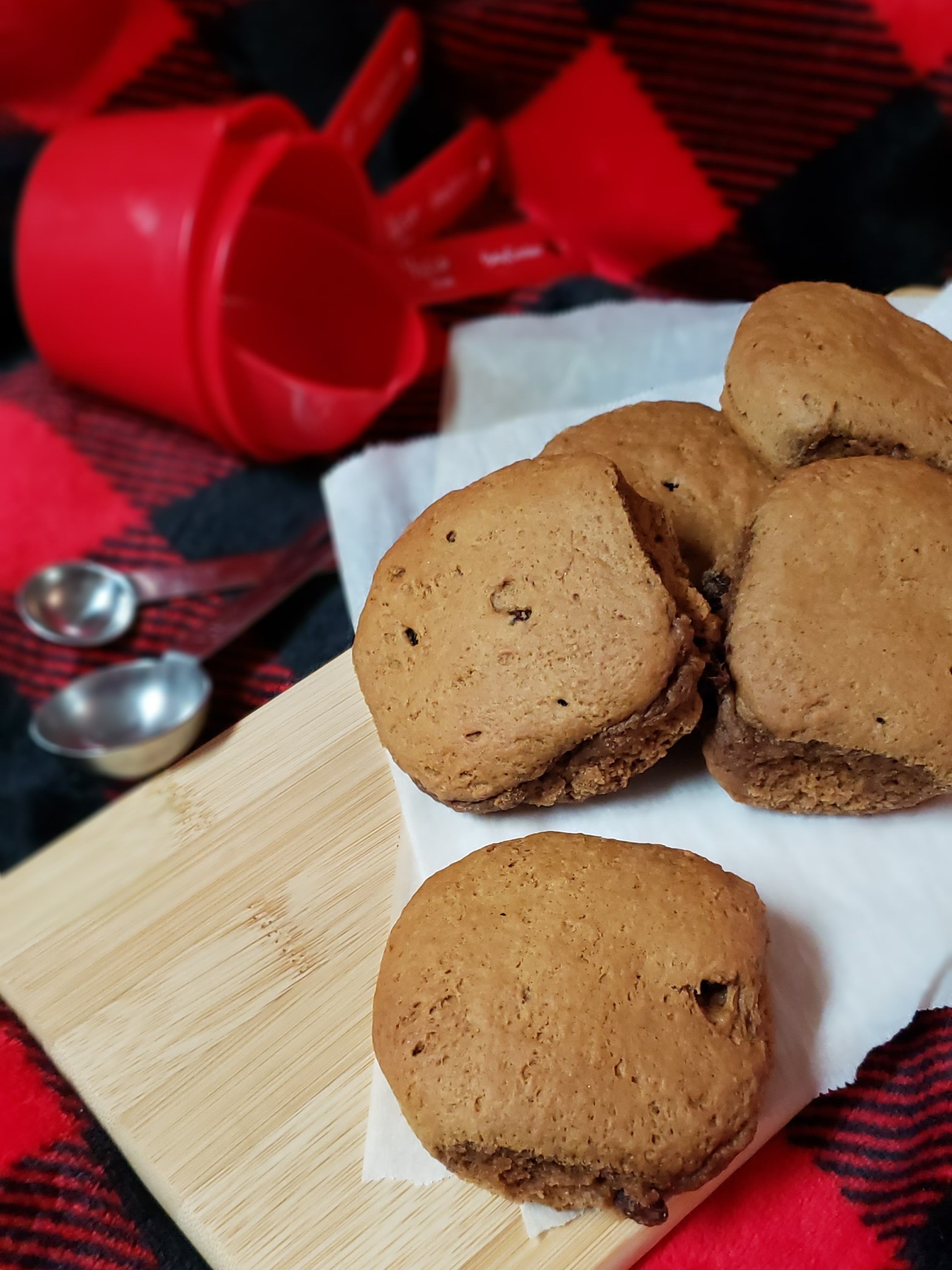
These spiced raisin buns, traditional in Newfoundland, are a cross between a soft cookie and a biscuit. Typical of Newfoundland hospitality and generosity, the lovely lady who finally shared this recipe with me had thus far met every request for the baking instructions with a freshly baked batch of Lassy Buns instead.

These sweet and flavourful “buns” are the perfect accompaniment to an afternoon cup of tea. They soften and the flavour becomes even deeper and richer if you can suffer leaving them in an airtight container for a day or two, but I can never restrain myself that long. I prefer mine served warm.


Newfoundland Lassy Buns

Ingredients:

  • 3  cups flour
  • 1/2 cup sugar
  • 1/2 tsp. salt
  • 1 1/2 tsp. baking soda
  • 2 tsp. baking powder
  • 1 tsp. cinnamon
  • 1/4 tsp. cloves
  • 1/2 cup raisins (soaked in boiling water for 10 minutes)
  • 1/2 cup butter (melted)
  • 1/2  cup molasses
  • 1/2 cup milk
  • 1 egg
  • 1 tsp. vanilla

Method:

  1. Heat oven to 400°F. Line a baking sheet with parchment paper.  
  2. Mix together all dry ingredients in a large bowl.
  3. In another bowl, combine melted butter, molasses, and milk, then add egg and vanilla.
  4. Add wet ingredients to the dry. Mix until just combined, then fold in the raisins. Let the dough rest for 10 minutes. 
  5. Scrape dough onto a floured counter and knead gently just until smooth. It will be sticky.
  6. Flour the dough lightly and roll out to 1 inch thick. Cut into rounds and place closely on a baking sheet with edges just touching.
  7. Bake 12 – 15 minutes. Do not over-bake; you want these to be soft and moist.

10 Notable Canadian Literary Magazines

If you’re a Canadian writer looking for a home for your work that’s a little more close to home, look no further. This is far from a comprehensive list, but what follows are ten quality literary publications that are based in Canada (with one exception). As always, familiarize yourself with what they publish before submitting, and follow their submission guidelines carefully.

Don’t forget, for literary magazines to exist, they need readers. Consider buying a subscription to support these journals as well as submitting your work. After all, the best way to hone your craft is to read widely, diversely, and insatiably.

The Antigonish Review

One of the oldest continuing literary magazines in Canada, The Antigonish Review is a quarterly literary print journal published by St. Francis Xavier University in Nova Scotia.

They accept submissions from around the world of: poetry, fiction between 500 to 3,000 words, translations, and creative non-fiction. It is a paying market, and there is a fee to submit—currently $3 for poetry and $5 for all other forms.

Blank Spaces

A Canadian literary arts magazine, Blank Spaces is published quarterly in print and digitally.

They accept submissions from Canadian creatives in the following categories:

  • flash fiction (under 1,000 words)
  • photography
  • art
  • poetry
  • creative non-fiction
  • fiction feature (up to 3,500 words)

There is a $6.00 fee to submit a fiction feature or $3.00 for anything else, but release months are also free submission months (September, December, March, and June). Blank Spaces is currently a non-paying market.

Dreamers Creative Writing

Dreamers Magazine is published tri-annually and sent to hundreds of subscribers across North America and Europe. It’s also sold in independent bookstores, as well as in Chapters, Coles and Indigo. Issues are also available digitally.

They are open to world-wide submissions of short stories, poems, personal essays or excerpts (that stand alone) from any genre. Accepted pieces are published on their website and authors will be paid a one-time $20 CAD honorarium. Three times per year, they select the best from among all the published online submissions for publication in Dreamers Magazine. There is a $3 submission fee.

Event

Event magazine is one of Western Canada’s longest-running literary magazines, and they welcome submissions written in English from around the world. Event publishes digitally and in print three times per year.

They are currently accepting submissions of fiction only, but see their website for the next poetry submission window and more information regarding submissions of non-fiction and reviews. There is no fee to submit. Contributors are paid $40/page for poetry and $35/page for prose, up to a maximum of $500, upon publication.

filling Station

filling Station magazine is a literary and arts magazine based in Alberta, published three times per year in print.

They are looking for submissions of previously unpublished poetry, fiction, creative non-fiction, critical non-fiction (about literature and occasionally about visual art), and visual art. Their mandate is to publish Canadian experimental literature in all its diversity and would like to promote artists who have been historically underrepresented; however they will also consider work from non-Canadian creators.

There are no submission fees and filling Station pays a $50 honorarium to contributors.

Grain

A literary print quarterly that publishes writing and art by Canadian and international writers and artists, Grain Magazine is based in Saskatchewan.

They accept submissions of poetry, fiction, and literary non-fiction, as well as queries for other forms of work. All contributors, regardless of genre, are paid $50 per page to a maximum of $250. They do not charge a submission fee.

Great Lakes Review

While not based in Canada, due to the focus of this journal I’ve included it on this list. Great Lakes Review publishes fiction, poetry, nonfiction, and photography from and about the Great Lakes region of the United States and Canada, both in print annually and on a rolling basis digitally.

Closed for submissions until September 1, 2022, but well worth keeping in mind, they consider fiction, poetry, nonfiction, and photography submissions. Be certain that either you are or have been a resident of the Great Lakes Region of the United States or Canada or that the manuscript you’re submitting involves the Great Lakes region of either the United States or Canada. Great Lakes Review is not a paying market.

Into the Void

An award-winning print and online literary magazine, Into the Void is published quarterly out of Vancouver, British Columbia. They are looking for fiction, poetry, creative non-fiction, and visual art submissions from around the world.

Into the Void has free submission windows during each reading period and offers $10 per poem, flash fiction or visual art piece, and $20 per long-form prose piece. Their current reading period, sadly, closed yesterday, but look for them to be accepting submissions again starting May 1.

Nunum

Nunum is an online literary journal dedicated to blending flash fiction and art, published quarterly. They operate out of New Brunswick, Canada.

They accept submissions of flash fiction of 500 words or less, as well as visual art. There is a fee of $3 to submit, and authors are paid $20 upon acceptance.

Parentheses Journal

An independent literary journal based in Ontario, Canada, Parentheses Journal publishes in print bi-annually, with issues releasing in April and October in print and digitally.

They welcome international submissions of poetry, prose, and art—do check their website for specific reading periods.

They do not charge for submissions and are currently a non-paying market.

A boldly honest manual on the finer points of ice-fishing

Find a frozen lake in Northern Ontario. This shouldn’t be too hard if you’re looking in February. They’ll all be frozen. Get yourself a friend, one who’s exceedingly outdoorsy. They’re bound to have connections with the cousin of a friend’s sister’s uncle who has a hut on a lake somewhere. They’ll be tripping over themselves to make all the arrangements, thrilled beyond belief that someone else is nuts enough to express interest in an outdoor winter activity.

Pack for the weekend. It’s going to be -30°C with a wind chill of instant frostbite and death to the extremities, so pack your warmest clothes. Think layers. Warm clothes are bulky, so you’ll need more than your teeny overnight bag, that’s for sure. Heave your giant suitcase into the back of your outdoorsy friend’s car, and try to buckle the seatbelt around your down-filled parka even though you can’t bend your arms and you’re rounder than the Michelin man in all your winter duds. Ignore their scoffing at how much you’ve packed for one night away.

Drive for an actual eternity, until civilization is so far behind that you probably have officially confirmed there is no edge of the earth.

Stop in a gas station/convenience store/bait shop/LCBO/post office in a nondescript village near your destination to buy minnows, use the toilet, and grab a cup of battery-acid-strength coffee that could almost eat though the Styrofoam cup it comes in. Drink the whole thing anyway, because the car heater can’t compete with the frigid wind and it’s worth the gut-rot to slightly warm yourself from the inside out.

Drive until your friend, increasingly excited as you delve further into the god-forsaken back country, says: “Look! We’re here!” Look around at nothing but white and rocks and snow and trees and ice and rocks and white and wonder what you’re supposed to be looking at. Follow their excited finger and squint until you can see a few dark specks in the distance on a flat expanse of white.

Inhale sharply and swallow your stomach back down to where it belongs when you realize you’ve just driven onto the ice. You’re on the ice. On a lake. In a car. Imagine the ice cracking and the car sinking into the deep, dark, deathly cold water. Try to breathe. Stop imagining. Try to breathe.

Get out of the car once it stops beside a tiny wooden hut that resembles an outhouse. Realize that your suitcase probably won’t even fit in there with you and your friend. Blow out your breath in puffs of air that plume like smoke. Feel your nose hairs freeze when you inhale.

Squeeze into the hut. Stand there awkwardly as your friend augers the ice out of the hole the last occupants drilled beneath an opening in the rustic wooden floor. Look down the hole and shiver at the blackness below the ice.

Peel off your mitts once your friend has a fire crackling in the little woodstove. Peel off your hat, and then your parka, and then your hoodie, and then your snow pants, and then wonder if you can peel off anything else as the temperature inside your little box rises and rises. Imagine the ice below you slowly melting and the whole hut dropping through, plunging you both into that blackness. Try to breathe. Stop imagining. Try to breathe.

Watch your friend thread a minnow gently on a hook and lower it down the hole to wriggle and flounder away, a tasty treat for a bigger beast, unbeknownst to the innocent little guy. Watch the line for signs of action for absolute hours. Wonder how it’s possible to be hot and cold at the same time. Wiggle your toes to see if they’re still there. Check your phone to see how long it’s been. Fifteen minutes. That can’t be right. Must be because there’s no signal here.

Watch the line. Wiggle your toes. Check your phone. Five minutes. Wiggle your toes. Take a selfie. Hashtag icefishing. Hashtag intothewild. Hashtag outdoors. Hashtag adventure. Still no signal. Stand up and stretch. Ask if it’s time for hot chocolate. No? We’ve only been here twenty minutes?

Peek down the hole again. Imagine a seal popping its head up through. Realize you have to pee. Inquire about where the toilet is. Regret. Regret hard. Regret this whole entire ill-advised excursion with every stiff and frozen bone in your body. Cross your legs. Write a tweet. “Ice fishing . . . More ice than fishing, apparently. And I have to pee.” Remember you have no signal. Try to breathe.

Tell everyone back at the office on Monday that you went ice-fishing, and bask in the flurry of attention over your outdoorsy wilderness adventure. Show them the picture of the fish that finally took the bait, the one you took at just the right angle to make its whole six inches look more like sixteen. Know that you will never go again.

Into the Wild (Jon Krakauer)

When I first saw the movie Everest, I developed a fascination with this peculiar group of people obsessed with summiting mountains, pushing their bodies to the extreme limits until life hangs by a thread. I had to learn more about the inner workings of these minds that seemed to put so little value on human life that they could climb past the frozen bodies of those who had gone before them to a place where their own body, starved for oxygen, was literally dying. I devoured books written by two of the members of that tragic May 1996 expedition, Jon Krakauer’s Into Thin Air and Anatoli Boukreev’s The Climb in an effort to wrap my mind around the senselessness of it. I was left with more questions than answers.

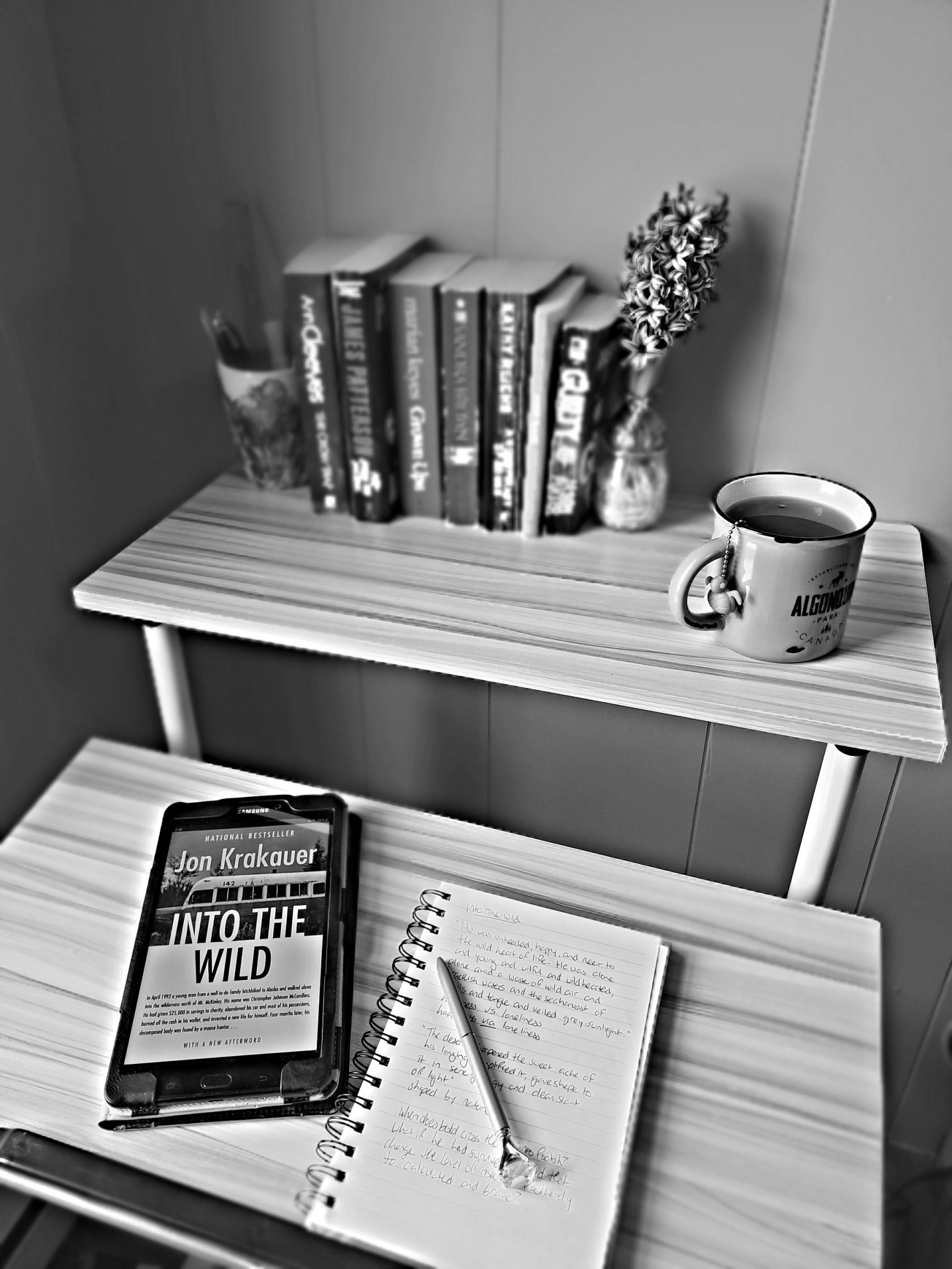
Just recently, the book Into the Wild, also by Jon Krakauer, crossed my Instagram feed and my attention was immediately captured. At first glance, I was sure that it was a clear-cut case of some stupid, selfish, reckless rich kid, feeling invincible, overconfident, running away to a wilderness where he had no business being.

“The prevailing Alaska wisdom held that McCandless was simply one more dreamy half-cocked greenhorn who went into the country expecting to find answers to all his problems and instead found only mosquitoes and a lonely death.”

But strangely enough, the more I read the more I started to feel that Chris McCandless knew what he was doing. He didn’t leave college, burn his money, and lose himself immediately in the Alaskan wilderness. By the time he reached Alaska he had spent nearly two years on the road, from July 1990 on, in all different climates and environs, living off the land, all his belongings on his back. When he arrived at the Stampede Trail in Alaska at the end of April 1992, he had good reason to believe he had the skills and the stamina to survive.

“He was green, and he overestimated his resilience, but he was sufficiently skilled to last for sixteen weeks on little more than his wits and ten pounds of rice. And he was fully aware when he entered the bush that he had given himself a perilously slim margin for error. He knew precisely what was at stake.”

Krakauer was more than thorough in retracing McCandless’ steps in the months leading to his death, and pursued an explanation for his demise with dogged determination bordering on obsession. This could perhaps be attributed to the fact that the author saw himself in Chris McCandless, a fact supported by a chapter in the book that recounts Krakauer’s own near-deadly foray into the Alaskan wild in his early twenties. It made me wonder, what if Chris McCandless had survived—would that change people’s view of the level of risk from foolhardy to calculated and brave? Krakauer’s own account of climbing the Devil’s Thumb alone reaches the same level of foolhardy as did McCandless’ venture into the wild, the only difference being: Krakauer survived.

“At that stage of my youth, death remained as abstract a concept as non-Euclidean geometry or marriage. I didn’t yet appreciate its terrible finality or the havoc it could wreak on those who’d entrusted the deceased with their hearts.”

It’s a tragic biography, but a thought-provoking one. It sparks discussion and raises more philosophical questions for every factual answer it provides. Jon Krakauer does a painstaking job of trying to get inside Chris McCandless’ head, but of course the only one who could possibly answer these questions would be the Chris McCandless of today, had he survived. I’d love to have a conversation with the man today, to get a glimpse inside his mind and see how he would reflect on the actions and decisions of his younger self with a few decades of experience between him and the tragic events.

The book is honest, at times funny, inspiring, and well-written, the story of a thinking, self-reliant young man on a quest for independence who viewed civilization as poison and believed nothing was worth doing unless it was difficult. The adventures of the self-styled “Alexander SuperTramp” broach the notion of happiness via loneliness, rather than the two states being at odds with one another. McCandless was comfortable in his own presence; he bore the burden of being alone with his own thoughts and entirely self-reliant and it did not break him.

“He was unheeded, happy, and near to the wild heart of life. He was alone and young and willful and wildhearted, alone amid a waste of wild air and brackish waters and the seaharvest of shells and tangle and veiled grey sunlight.”

James Joyce, A Portrait of the Artist as a Young Man

Butter Tarts for Two

The butter tart is quintessentially Canadian—so much so that across the country you can find festivals, competitions, and tours dedicated to the sugary treat. The criteria for a perfect specimen are as varied as Canadians are. Should the filling run when you bite into the tart? Should the pastry be made with butter or lard? Pecans or raisins? The debates rage on.

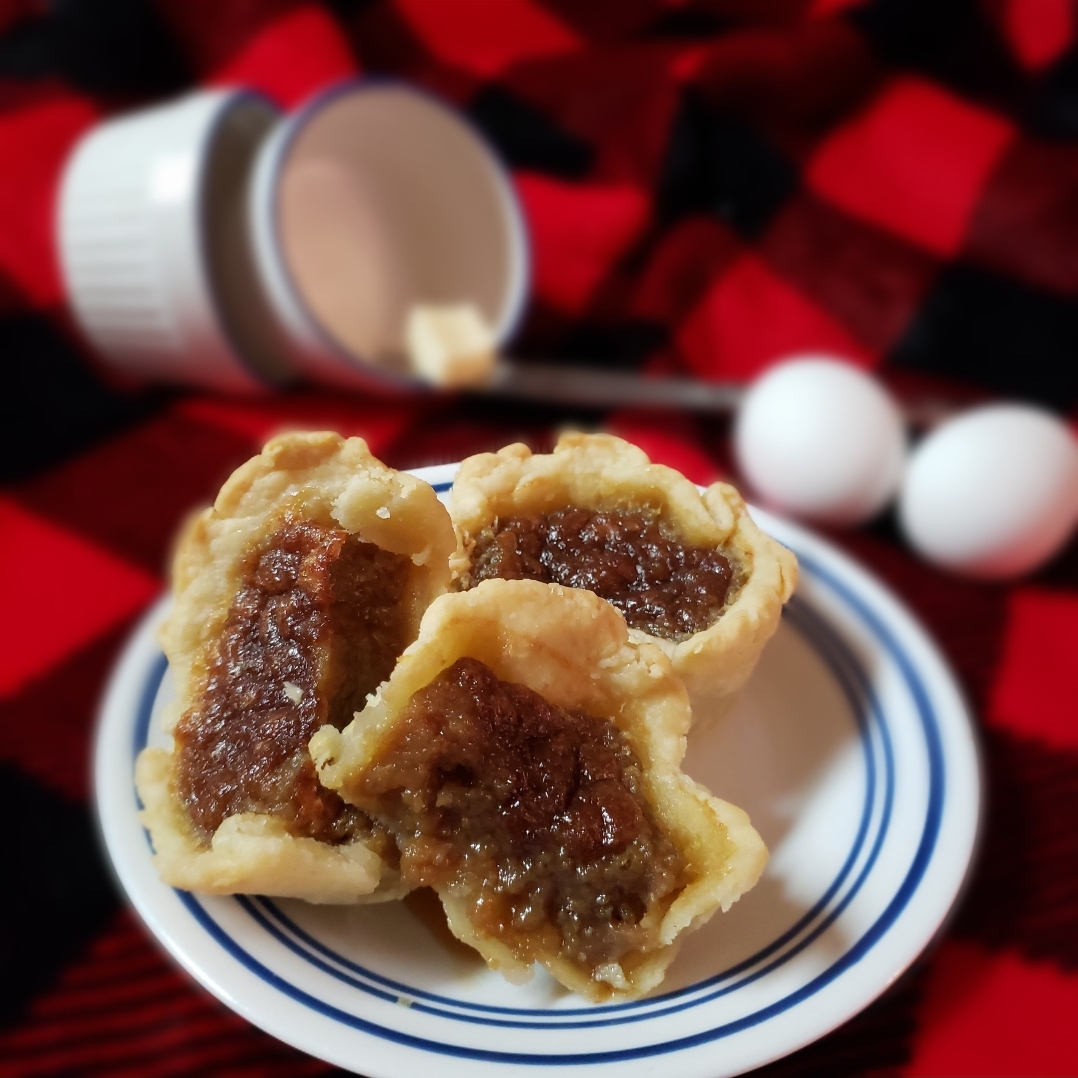
Personally, I look for a flaky all-butter pastry with a filling just on the firmer side of gooey. Raisins are an absolute no from me, and while I can tolerate pecans, I prefer my butter tarts to be unadulterated.

What follows is a recipe for small-batch butter tarts. These sugar-packed pastries are divine, but best enjoyed rarely and in small doses. I’ve been on a quest to perfect a “single-serve” butter tart recipe for quite some time; no one with as little self-control as I have needs to be pulling a dozen of the things out of the oven at home. The challenges in mixing up one single butter tart are prohibitive, and so I landed on this pair of ramekin-sized beauties. This recipe tends toward a firmer middle depending on how large your egg is, and has a slightly custardy flavour that is heavenly with the hint of maple syrup.


Ramekin Butter Tarts

Ingredients:

  • Pastry:
    • 1/3 cup flour
    • 2 tbsp cold butter
    • 1-2 tbsp cold water
  • Filling:
    • 1 egg
    • 1/3 cup brown sugar
    • 2 tbsp maple syrup
    • 2 tbsp melted butter
    • ¼ tsp vanilla
    • Pinch of salt

Method:

  1. Preheat oven to 350°F.
  2. In a small mixing bowl, work the butter into the flour with your finger tips until it resembles coarse breadcrumbs. Using a butter knife, stir in the water, a little bit at a time just until the pastry starts to come together.
  3. Spray two ramekins with cooking spray. Divide the dough into 2 and form roughly into a ball. Roll out each ball into a circle roughly 10-12 cm across. Gently press the pastry into your ramekins, being careful not to puncture any holes. (If the filling leaks, they will be very difficult to remove from the ramekins.)
  4. Beat 1 egg, then beat in the brown sugar and maple syrup. Add melted butter, vanilla, and salt, and stir to combine.
  5. Pour the filling into the prepared tart cases and place on a baking tray.
  6. Bake until the pastry is golden at the edges and the middle of the filling has a slight wobble, approximately 18 minutes for a runnier filling and up to 22 minutes if you like a firmer filling.
  7. Set ramekins on a wire rack to cool for at least 15 minutes before attempting to remove the tarts. You may have to run a knife around between the pastry and the ramekin to loosen the tart.

Makes 2 large butter tarts. Best enjoyed with a strong cup of coffee.

What Makes a Poem a Poem?

An internet search for the answer to that question leads you down a rabbit-hole the complexities and tangents of which could be the occupation of a lifetime. Poetry is a term that rebuffs all definition. It is a form of literature too multifaceted, too abstract to neatly define. To be sure, many have opinions on the matter, criteria they impose upon the craft, but poetry refuses to be contained by rules and regulations.

In an attempt to define a poem, many cite the elements of sound play that poets oft employ. Rhyme, rhythm, meter, alliteration, simile, onomatopoeia, the list goes on. These are merely the tools, not the craft itself.

Intuitively, you may read a piece of literature and be sure that it fits beneath the blanket terms of either prose or poetry. Alternatively, you may read a piece that has been labeled as one or the other and just as surely feel that the label is mistaken. Some prose is very poetic and some poetry is by design prosaic. The whole art form is so subjective; I feel it would not be inaccurate to say that poetry cannot be defined.

That being said, what follows are four main elements that I personally find intrinsic to poetry, the nearest thing to a definition that I am willing to propose:

 Emotion

“Poetry is when an emotion has found its thought and the thought has found words.”

Robert Frost

Poetry bends language to convey emotion. A poem should make you feel.

Symbolism

“Poetry lifts the veil from the hidden beauty of the world, and makes familiar objects be as if they were not familiar.”

Percy Bysshe Shelley

Poetry surpasses the literal, disguising layers of meaning within words that say more than what appears on the surface and often require some untangling to understand. A poem should make you think.

Language

“Poetry should surprise by a fine excess and not by singularity—it should strike the reader as a wording of his own highest thoughts, and appear almost a remembrance.”

John Keats

In poetry, words are strung together in ways that defy the usual grammatical rules, in ways that take advantage of the lyrical and performative aspects of language. A poem should make you hear.

Imagery

“Painting is silent poetry, and poetry is painting that speaks.”

Plutarch

Poetry uses often sparse but always striking details to conjure up strong images. A poem should make you see.


Being so subjective, it is natural that some poetry will make you shrug and think I don’t even know what that means or even That’s not a poem, while the same piece for someone else will pierce directly to the heart and draw out deep emotion. It is much like that abstract painting on a gallery wall that elicits both awe and scorn. The line between poetry and prose is imaginary and flexible.

It is both as simple and as impossibly complex as this: A poem is a written work that the author considers to be poetry.

Salar de Uyuni

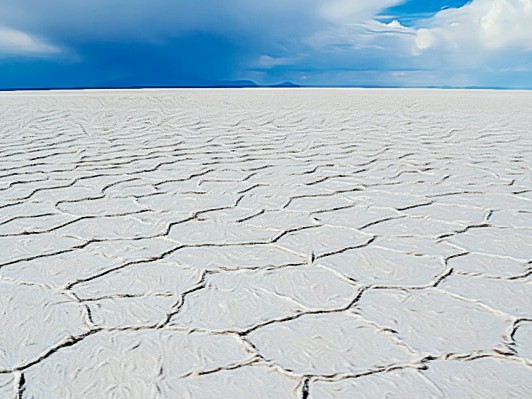
In the day, it’s a crusty hot expanse of blazing white. Nothing but that blinding white. It’s unwelcoming. Life is hard-pressed to find a home here, in this lithium legacy of a prehistoric lake. Cacti, as prickly as their salty abode, bristle an unfriendly warning. In a brackish lagoon, a noisy flamboyance of flamingos strut. They bring a startling burst of colour to this otherworldly monochrome.

So flat, so far, stretched out beneath the unforgiving sun. Crystalline hexagons form as briny water evaporates, lucky molecules escaping their salty incarceration to find freedom drifting with a sparse wisp of cloud. Blue above, white below, and a jagged shadow line away off in the distance. There are mountains there, somewhere, far beyond the white. The tenuous breath of fugitive vapors heads that way, borne along on some invisible air current to rendezvous with a gentle rain shower over the distant jungle.

But I stay here, left behind. My birthplace, as harsh and stingy as the tourists I drive across the salty surface to catch their Insta-worthy snaps. They flock here, as noisy as the flamingos, and as flamboyant. Influencers whose world exists inside their phone, hurrying to digitalize and monetize the starkness and the greatness. They pose for the same clichéd optical illusion shots, each group thinking their selfies more original than the last.

But nothing is new here. The salt has seen it all.

That is the reality of the daytime. White and flat, shining and crispy. But the night, oh but the night.

The fiery ball of sun disappears, dipping down below that rigid far-off line. The blackness comes, the darkness comes. A brief sprinkle of rain kisses the salt with its magical layer of water. As the moon and stars appear, blinking their way into the night, the Salar transforms before me. Glassy smooth, perfectly clear, my saline home opens itself to the sky and reflects the universe back to me. A billion galaxies glimmer just for me, from above and below, the horizon line now blurred until up and down are the same. This is my moment of freedom. This is my escape.

And here, as I stand on the edge of eternity, face to face with infinity, a single salty tear slides down, drips down to join the brine and let the whole hopeful circle begin again.


This piece was first published in print as part of the Writers of Tomorrow anthology by Wingless Dreamer.